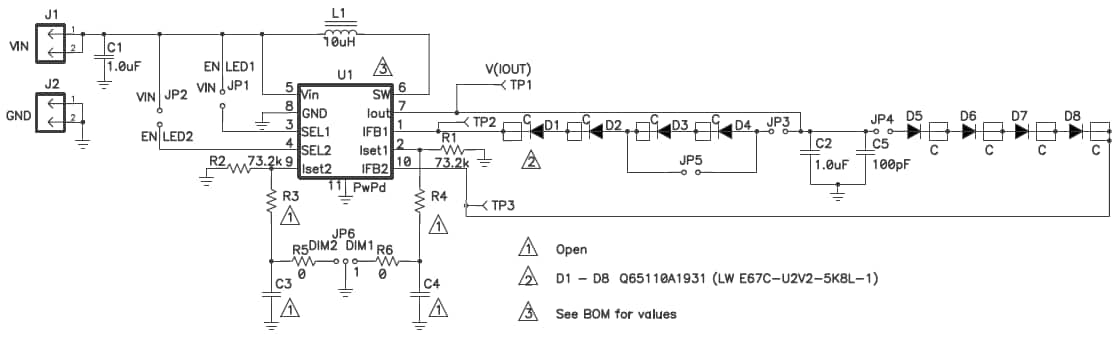
Whenever a lighting application, such as street lighting for example, requires an elevated number of LEDs, there are basically two solutions: the first is to connect all the diodes in series in a single "string"; the second is to place several strings in parallel with fewer elements in each one.
The Texas Instruments TPS61150EVM-150 evaluation module contains the TPS61150 IC. This EVM provides two independently regulated current outputs using a single inductor step-up (boost) converter.
This evaluation board is designed around an L6902D-based DC-DC converter with dimming interface. It board implements both of two well known dimming methods:
- Analog current control - Average current control by PWM
The ZXSC400, although designed for small LEDs in LCD backlighting, is sufficiently flexible to provide an efficient 1W solution producing a nominal 350mA constant current source from 2 NiMH or NiCd cells.
This design note shows a typical ZXSC310 LED driver circuit for a solar power garden light. The input voltage ranges from 1.7V to 2.5V with a maximum output current of 160mA at 2.4V input.
The ZXLD1350 is a continuous mode inductive step-down converter, designed for driving single or multiple series connected LEDs efficiently from a voltage source higher than the LED voltage.
The CAT4201 is a high efficiency step-down LED driver from Catalyst Semiconductor. This device is designed to drive high brightness LEDs up to 350mA from a power supply up to 28V. The LED brightness is controlled by a single resistor from the RSET pin to GND. Analog dimming and idle mode control are available through the CTRL input. An external circuit is provided on the CAT4201AEVB for PWM dimmin…
The L6920D is used in this flashlight application as it is a high efficiency step-up controller that realizes the conversion from battery voltage to the selected output voltage with only three external components.
L6920D has a startup voltage of 1V and its operating input voltage ranges from 0.6V to 5.5V.
This evaluation board showcases the LM3409HV PFET controller for a buck current regulator. It is designed to drive 12 LEDs (VO = 42V) at a maximum average LED current (ILED = 1.5A) from a DC input voltage (VIN = 48V). The switching frequency (fSW = 400 kHz) is targeted for the nominal operating point, however fSW varies across the entire operating range.
The LM3404HV circuit and BOM have been designed to provide a constant forward current of 1.0A to a single LED with a forward voltage of approximately 3.7V from an input of 48V ±10%.
Over the input voltage range of 6V to 75V the average LED current, IF, is 1.0A ±10%, the ripple current, ΔiF, will not exceed 400 mAP-P, and the switching frequency is 200 kHz ± 10%.
 Compra